The Dangers of Creativity in Chess Calculation
The Confusing Art of "Just Making Moves"

Hello subscribers. This is going to be a bit of a long one, so buckle in. It’s been a bit since I’ve posted to this blog, but I assure you I have been hard at work towards USCF National Master as I’m on pace to play nearly 100 classical games in 2025. In general, my relationship with writing about chess is just going to be that I will write when I feel I have something interesting to say. This often coincides with wanting to solidify that chess concept in my own mind. This is the first time that has been the case in a while, as I’ve mostly been in the lab. Once I hit National Master, I think I’ll feel even more over confident in my assertions, and I expect I’ll write more often due to that.
I started 2025 at USCF 2109, and as of starting to write this post on 7/22 I am sitting at USCF 2160. The last 50 points are proving very difficult, but given my progress and amount of work I’m putting in I’m very confident I’ll achieve it at some point (hopefully in the next 12 months or less).
Generally, my issues are: everything. My openings with the black pieces are a bit too lazy in some lines, my tactical vision could be improved, my theoretical endgame knowledge is quite low, etc. Getting to 2150 strength has largely been thanks to my off and on work with GM Perelshteyn, who has taught me how to analyze my openings deeply and many many things about practical tournament chess play. In the last 3 months, I have been focusing on targeting the main weakness in my game that is universal not only to all chess players, but all stages of the game: Calculation.
First off, what is ‘Calculation’ in chess? There are a lot of different recommendations on the ‘how’, starting with Kotov’s Tree of Analysis. The ‘What’ is often ‘mutually understood’ yet not fully explained in chess discourse. It’s generally described as ‘tactics but deeper’.
I think Substack writer ‘Sam Asaka’ in his chess blog ‘Road To Infinity’ covers it excellently with this visual.

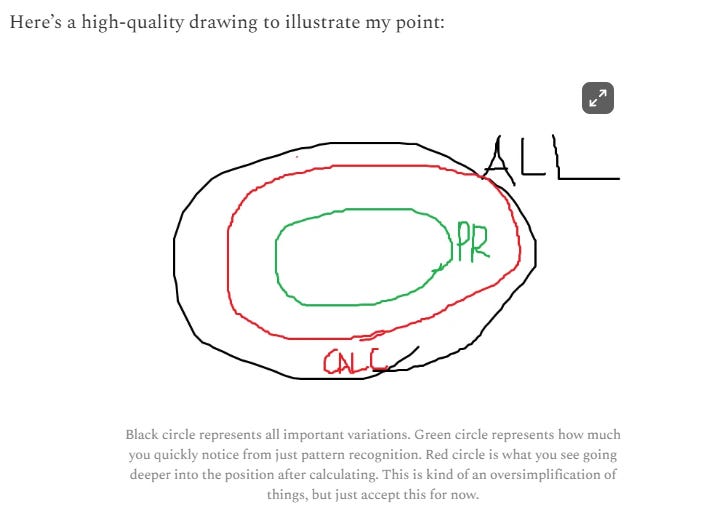
Calculation is widening your ‘red circle’ of vision of the ‘total truth’ of the position. The green circle is what you see instantaneously through pattern recognition. A grandmaster’s ‘green circle’ may be larger than even a National Master’s ‘red circle’, so they could beat them at a high clip even if they made every single move instantly, and the National Master had some reasonable amount of thinking time. This is also why we watch in awe as GM Nakamura tears through a puzzle every half second in puzzle rush. His ‘green circle’ is just bigger than the first 50 or so puzzle’s ‘Circle of Total Chess Truth’.
How does this tie into some recent epiphanies with understanding chess in relation to my own games? Late last year I had a game against FM Avi Kaplan, that tore my heart out of my chest. I was only a few points off my all time rating high, going into the final round of a ‘Expert/Master’ section of the IL State Championship. I play a bit of an odd ball Qxd4 line against his Sicilian, and Avi allows me to get a nice positional edge on the dark squares. We play a few more moves, and I’m able to loose what I feel is a beautiful tactical shot.
f4!
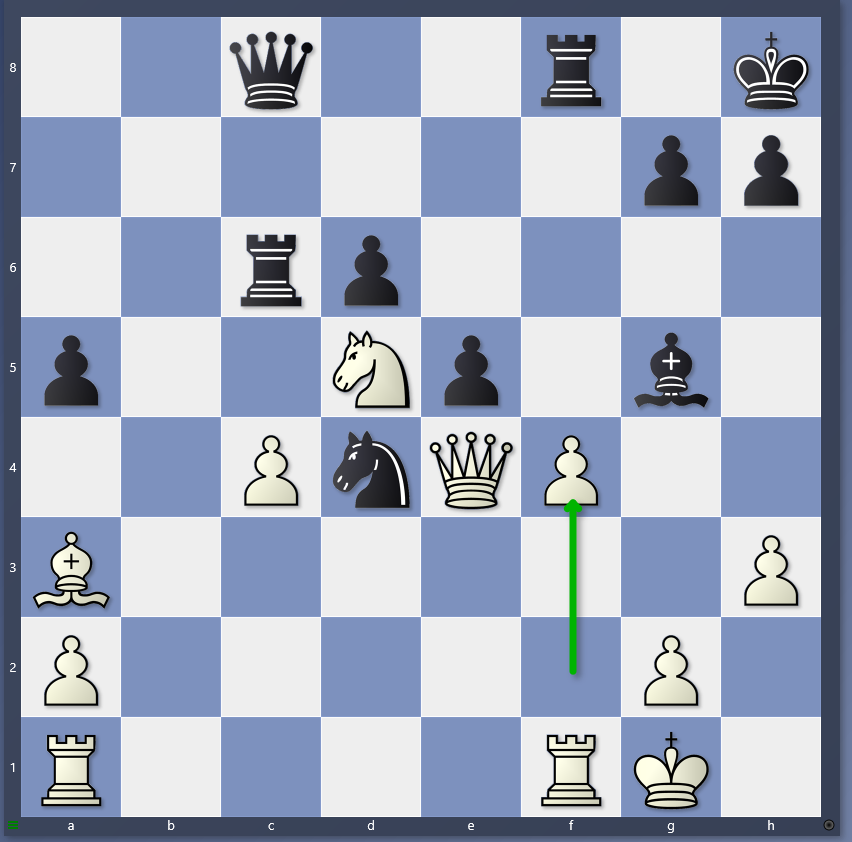
Without filling the text up with lines, any set of captures on f4 fail due to the loose knight on d4, and moving the bishop anywhere allows fxe5 and the pinned d6 pawn leaves black’s position in a miserable state. Avi is briefly in shock, and then begins laughing silently, looking around the room for a few minutes. (Side note: Avi’s propensity for laughter during a chess game actually bothered me a bit the first time we ever played, but after getting to know him better, I feel it comes from a place of immense joy while playing the game and not any level of disrespect). After a few minutes, Avi calculates and finds the computer approved best move of 27…exf4, a very impressive show of ‘lack of materialism’. Giving up the full knight on d4 to prevent any further fireworks, he cuts off an arm to protect the body.
The game continues on, and suddenly I’m playing an entirely new player. Every move is a threat varying from childish to machiavellian. Playing nearly instantly, pressing me on the clock that I grow more and more aware is only a g60 with delay 5. I spend a lot of time being careful, avoiding tricks and hidden knockouts, and we reach this position:
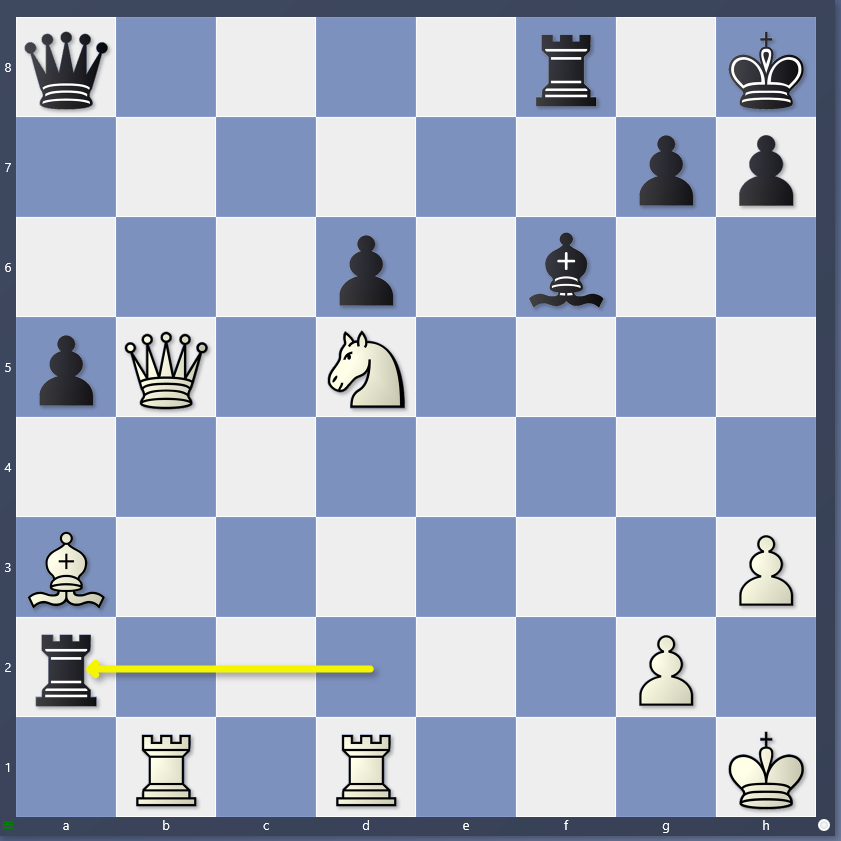
The best move is simply Bb2!, forcing further trades while up a piece. A concept that I teach brand new players; “If you are up in material, trade pieces”. I instead calculate a long line that starts with Bxd6, play that, and shortly after hang a piece in time trouble on the d file due to a skewer.
Gritting my teeth in anguish, I spoke with Avi about the game afterwards. While he taps the moves and some light lines into a Lichess analysis board on his phone, a different FM who was watching our analysis has a comment on the game. “Ah yeah in that position, once you got up the piece, to win you just have to make moves”. I was incredulous. ‘Just make moves’. I made LOTS of moves and look what happened! In the state of psychological pain I was in at the time, this comment really cut me. A stronger player commenting on the simplicity of such an “easy” conversion, how typical!
I drove home. Sitting with my board game pain on I-41, driving in the dark, and my frustration slowly turned to consideration. Maybe I’m misinterpreting his comment. Maybe he was right. Maybe I DO just need to make moves.
I met with one of my ‘as needed' coaches, NM Nolan Hendrickson, to talk about this. How can I be faster, and ‘just make moves’ in winning or better positions? His answer: just do! Practice moving as fast as possible without blundering. He noticed in many of my games that my analysis had notes about being in time pressure, and suggested I play aggressive but prepared openings to press my opponents in the opening, and then after that only make quick/safe moves unless there is a clear knockout. I took his advice, and my blitz rating shot up from 2320 lichess, to 2420, and my classical USCF began rising again back up again over 2100, to 2140. Of course, how simple! Then, something interesting to me, but expected to others, happened. In classical I began blundering in quite silly ways, even with NO time pressure on me. Three classical examples during this ‘fast as possible without blundering’ attempt:
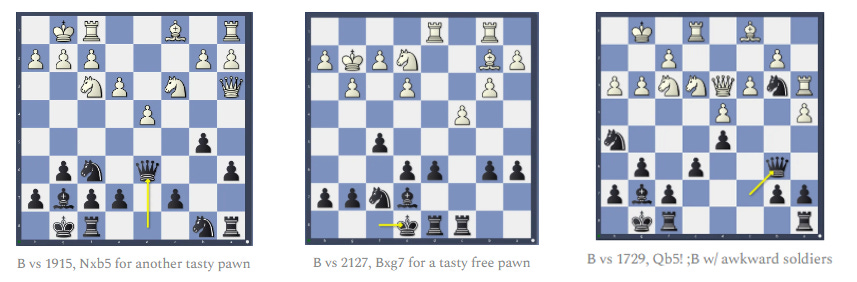
If I was moving ‘quickly but safely’ as Nolan recommended I could’ve certainly avoided these mistakes, I had a feeling something wasn’t exactly right about this strategy for me. I began getting lessons weekly with GM Alex Goldin after getting positionally crushed by him in a local tournament. Our emphasis immediately, was a plan of intense practice organizing my calculation process, to prevent these type of silly mistakes. The focus is on following the steps of a clean process, and ignoring the results of this work, just having a correct process and repeating it over and over again like a layup in basketball. While treating the symptom, GM Goldin recently pointed out a disease: “You want to play creatively! You are not yet strong enough to be creative, you need to master ONLY playing principled moves. Then, you can play creatively. Only do what you know how to do during the game. No ‘analyzing’ during the game”.
I went back through my recent games, he was completely right. I didn’t need to just move fast, I needed to make ‘normal’ moves fast! Develop pieces, castle, protect threats, trade pieces. I was using my creativity to shun the basics of chess far too often. Even in the 3 examples I posted above: in example 2, why would I move my king rather than improve a piece? In Example 3: why is my knight on the rim on h4? Those don’t seem like principled decisions.
Then I realized why moving faster IS working to a degree. I am treating a symptom, but masking the disease: I wasn’t giving myself enough time to think creatively. My green circle was only allowing me to make simple moves! Here are a few more positions from my classical games where I attempted beauty, shunned the basics I know too well, and was punished:
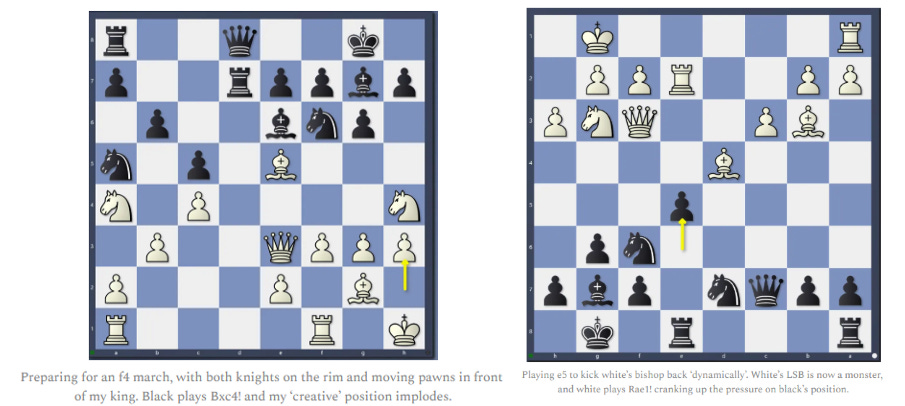
To master the art of ‘just making moves’ well enough to reach National Master, I need to move quicker but even more importantly, I need a much stronger emphasis on making principled moves with those quick decision. Some notes on how I plan on implementing this into my game in the coming months:
When I play blitz, only focus on making principled/simple moves, avoiding creativity. Especially in the opening.
If I find an idea I find beautiful in classical, only calculate it for a maximum of 3 minutes. If I am not fully convinced, abandon it for a simple move. (GM Goldin recommendation)
More emphasis on the first step of ‘observation’ of the calculation process, doing it every move before looking for candidate moves, in all time controls and chess work. It’s easy to find beauty when you ignore one to two move threats from your opponent!
In summation, to cover the final stretch to 2200 I need to get slightly better at every aspect of my game. Chess is frustrating and wonderful in that way. Though, I think understanding and applying the power of ‘Just Making Moves’ is going to be a large pillar of that work. Hopefully the next time you hear from me, it’s in celebration of a goal completed! Otherwise, I’ll be happy to write yet another rumination on chess improvement. Thanks for reading, and I’d love to hear any feedback you all have in the comments, or DM me on twitter @ChessLobster. In an Ocean of Chess, thanks for reading my blog.
Great post Evan, it always feels a bit unlucky when your opponent misses something and then gets annoying counterplay, because it also often alters the psychology of the game. You will get there though!
I recognize one of those positions 🤣